

























































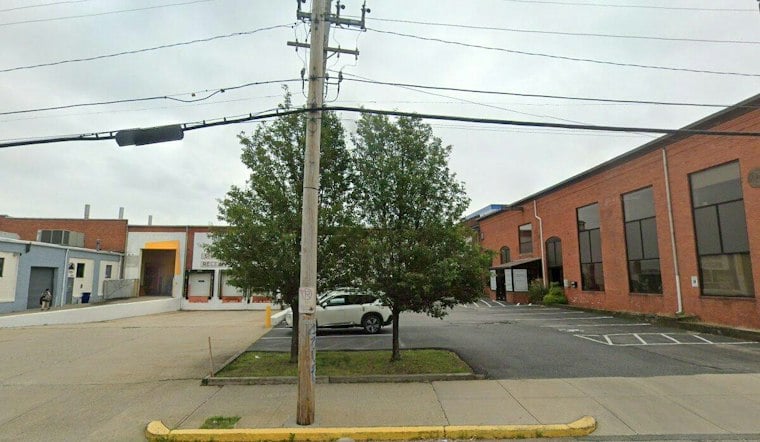
A textile mill in Providence's Valley neighborhood has become a hub for small businesses, artists' studios, and job-training programs — a creative-reuse model that could offer ideas for the Hub's increasingly empty laboratory towers. The mill, known as 50 Sims, is adding a graffiti-covered courtyard and converting a former whiskey-barrel storage space into two more floors of studios.
The timing is pointed: Massachusetts lab and manufacturing space vacancy reached 31.1 percent by mid-2026, while creative reuse offers one possible approach to underused buildings.
Why a 113,000-Square-Foot Mill Matters to Boston
50 Sims is a former textile manufacturing plant that Scout began redeveloping in partnership with the Providence Redevelopment Agency starting in 2021, according to the same report. The 113,000-square-foot building now serves as a hub for Rhode Island's creative community, job training programs, and businesses, housing artists, small businesses, job training programs, and Buttonwoods Brewery.
50 Sims brings artists and small businesses together with job-training programs.
Creative Businesses Find Room at the Mill
Felicia Neuhof founded Shellf Life at the building, making architectural surfaces, furniture, bowls, and lighting from discarded seafood shells.
Scout plans to convert its former whiskey-barrel storage space into two floors holding 28 studios and workshop spaces, accommodating 60 more cultural and creative producers once construction begins in December. The project also calls for windows overlooking the courtyard. A separate 21,180-square-foot structure known as the Shed is part of the site.
A Larger Playbook Built in Philadelphia
Scout's experience extends well beyond Providence. The developer renovated Philadelphia's Bok Building, a former South Philadelphia school that includes a rooftop bar. Scout has since expanded its Philadelphia footprint further, acquiring two former University of the Arts buildings for $12.25 million in February 2025 to build the Village of Industry & Art, a 110,000-square-foot creative campus with 35 long-term rental residences for artists earning 60 to 80 percent of area median income and 10 short-term residences, with completion expected by mid-2027, as reported by PhillyVoice.
The Armory Deal That Fell Apart
Scout had proposed a longer-term agreement to redevelop the Cranston Street Armory. During a Philadelphia visit, a state official faced allegations of inappropriate and unprofessional conduct. That year, Governor Daniel J. McKee's administration ended Scout's contract to redevelop the armory. Separate reporting from the Associated Press detailed the episode involving former state property director David Patten; he resigned and received a $5,000 state ethics fine in March 2024.
Boston's Own Vacancy Crisis
The scale of Boston's empty lab space reflects a boom-and-bust cycle in life sciences. Statewide lab and manufacturing space vacancy climbed elevenfold, from 2.7 percent in 2021 to 31.1 percent by mid-2026, according to biopharma trade association MassBio's data reported by Fierce Biotech. That surge followed a construction wave that took life-sciences real estate from 21.5 million square feet in 2015 to more than 60 million square feet by 2023, as pandemic-era biopharma funding fueled speculative building across Greater Boston.
Artists Have Been Here Before
Separately, Hoodline has previously reported that non-biotech tough tech startups — AI, robotics, and hardware-focused medtech ventures — have tripled their share of Boston lab leases over four years, taking roughly 30 percent of leasing volume in 2025 as landlords sought any tenant willing to fill empty floors.
Whether Boston adopts anything resembling the 50 Sims model remains unsettled. For now, the mill on Sims Avenue stands as a working example of incremental, artist-driven redevelopment — an approach that may offer lessons as Boston grapples with surplus space.




